Outplacement

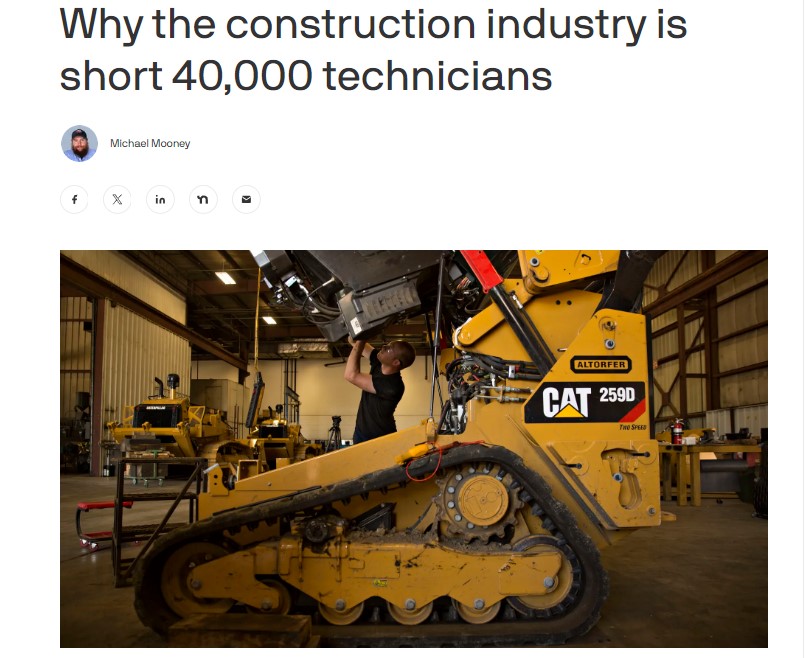
Why the construction industry is short 40,000 technicians


Caterpillar, the Irving-based construction equipment manufacturer, wants its dealers to hire 40,000 new technicians in two years to stem a global shortage.

Even before the pandemic, 70% of employers reported having trouble filling roles requiring skilled labor, per Bloomberg.

State of play: Not only are manufacturing giants like Caterpillar having trouble finding the workers to build this equipment, dealers are struggling to hire people to maintain and repair that equipment, Griffin Reome, the company’s manager of workforce development, tells Axios.

A lot of the technician workforce is also starting to retire, and the company is scrambling to transfer that institutional knowledge to a new generation.

Flashback: Caterpillar has watched this problem evolve over decades.

“We have articles within the Caterpillar organization that date back to the 1960s, talking about the skills gap and how people are being pushed into the post-secondary college route versus going into the workforce,” Reome says.

What they’re doing: The company created a development program that pays people to train and targets a wide range of potential workers, from recent high school graduates to military veterans to mothers who’ve been out of the workforce for years.

The company is also leaning into recruiting events — often alongside its biggest competitors like Komatsu and John Deere, who are having the same issues, Reome says.

“This is certainly an all-hands-on-deck issue.”

Plus: They’re working to hire women, who account for a mere 3% of the technician workforce in the U.S.

Technology shifts have made the job less labor-intensive and more accessible.

“You don’t have to be a 200-pound male,” Reome says. “And you won’t need a shoulder replacement when you’re 40.”

What they’re saying: “Women can easily do the job as efficiently as their male counterparts,” he says.

“Some would even say they can do it better because of the attention to detail and the ability to multitask.”

By the numbers: Though the company won’t release its pay scale, Reome says Caterpillar technicians make “20% over the median household income within the U.S.,” which amounts to a salary of about $90,000 a year. (c) Michael Mooney – axios

Employers you can get further help and Information by messaging us here or email SkilledMigrationGroup@protonmail.com


#CAT #caterpillar

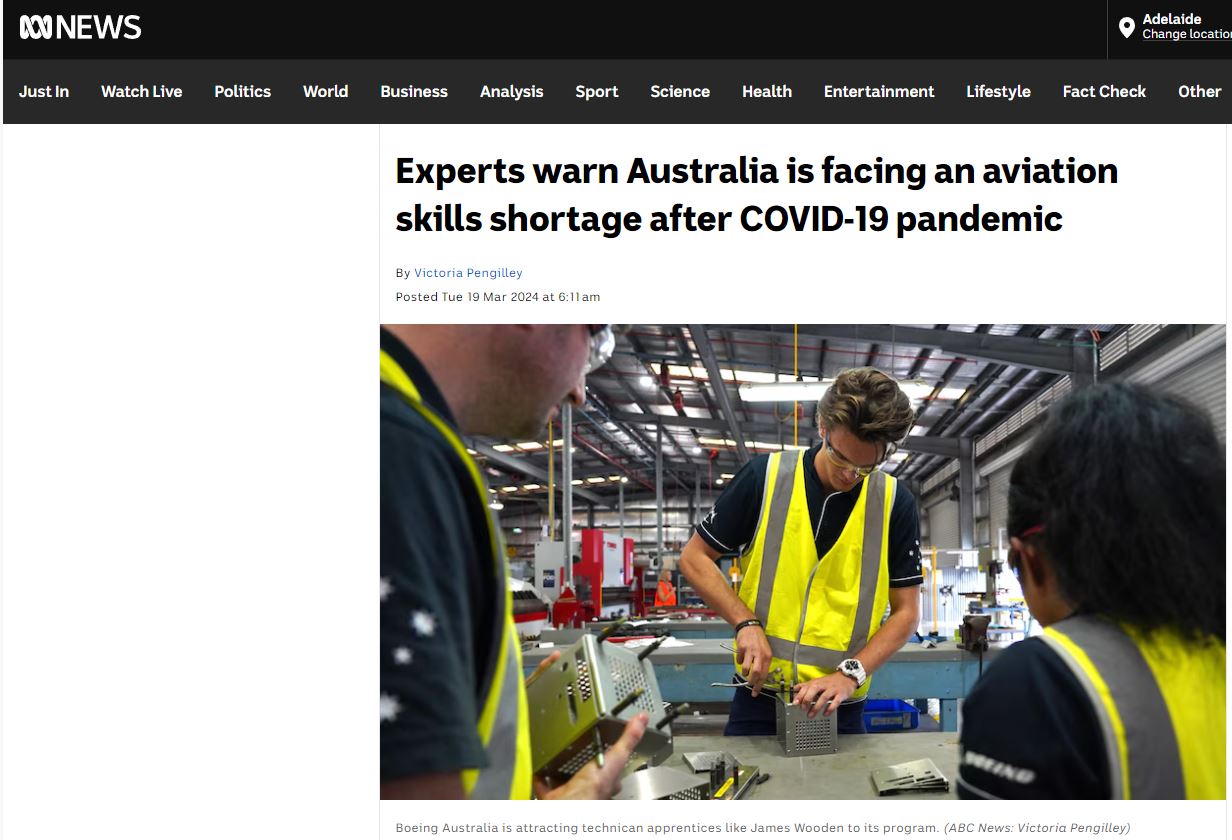
Experts warn Australia is facing an aviation skills shortage after COVID-19 pandemic (c) ABC news Victoria Pengilley

In short: There are fresh warnings Australia is facing a skills shortage in the aviation industry. “Everyone wants to be a pilot but there’s a gap in the market for technicians,” she said. “The industry has job ads going out for 6 to 12 months with no qualified person applying.” From pilots to baggage handlers, maintenance, repairs and technicians – the aviation sector is contending with a worker shortage. An estimated 25,000 people left the commercial industry during the COVID-19 pandemic after airlines made drastic staffing cuts and accreditations lapsed. In the years following, many workers retrained in other industries and didn’t return to aviation.

Employers you can get further help and Information by messaging us here or email SkilledMigrationGroup@protonmail.com

For Employers – Watch this 3 Minute Video – The Problematic Skills Gap in Heavy-Duty Technicians

The lack of standardized training creates hurdles for heavy-duty technician recruitment and retention. Unlike OEM dealerships with clear standards, independent dealerships face a different reality. The Heavy Duty Parts Report.
Employers you can get further help and Information by messaging us here or email SkilledMigrationGroup@protonmail.com

https://lnkd.in/gX64mAhx

#heavydutytechnician #truckmechanic #dieselmechanic

Rising apprenticeship dropouts adding to skills shortage problem in Australian construction

Skills shortage continues to impact the Australian construction industry – a vital contributor to the country’s GDP and economic growth – with just a little over half of trade apprentices completing their training.
While the Australian Apprenticeship System delivers a pipeline of skilled, trained individuals to the construction industry, apprenticeship completion rates remain a key area of concern. National data reveals that just 54 per cent of trade apprentices who started in 2017 completed by the end of 2021, down from 57 per cent of those who started a year earlier; one in three now drops out in their first year.

AUSTRALIAN WELDERS MORE THAN CAPABLE OF BUILDING AUKUS NUCLEAR SUBMARINES—WE JUST NEED MORE OF THEM

In March, Weld Australia confirmed that Australia’s welders are more than capable of building the new fleet of eight nuclear-powered submarines agreed to in the $368 billion AUKUS deal. However, the biggest risk facing the nuclear-powered AUKUS submarine build is whether enough skilled welders can be recruited and trained. As such, Weld Australia is calling for a Shipbuilding Welding Academy to be established and funded by the Federal Government.According to Geoff Crittenden (CEO, Weld Australia), “There has been some discussion in the media over whether the quality of Australian welders is sufficient to build the proposed AUKUS nuclear-powered submarines. Australia’s qualified welders are more than capability of building the new fleet.” “Some pundits have stated that the quality of welding required for a nuclear submarine is of a much higher standard than that required for a diesel electric conventional submarine. However, all welding must be of the highest quality if the submarine is to meet the necessary survivability objectives—whether the submarine is nuclear or diesel powered is irrelevant.” “Whilst some welding on nuclear boats is undertaken in line with different International and Australian Standards, and utilises different materials, the quality of the weld must be the same: that is to zero defects.”The biggest risk facing Australia’s nuclear-powered AUKUS submarine build is not welder capability, but the recruitment and training of enough skilled welders.“Australia is already facing a severe shortage of skilled welders. Even before the AUKUS deal was signed, Australia was looking at a shortage of 70,000 welders by 2030. So, unless we take serious precautions now, there simply won’t be enough skilled people to undertake the welding required,” said Crittenden.

Weld Australia Welcomes Energy Apprenticeships Program—But More Work is Needed

According to Geoff Crittenden (CEO, Weld Australia), “There is no magic solution to Australia’s skills crisis. We need a radical approach. The same old approach that we’ve taken for years will not arm Australia with the skilled workers needed to deliver the record number of projects we’re seeing in industries like defence, renewables and infrastructure.”
“A veritable army of skilled workers, including welders, will be required to build and install the infrastructure needed to achieve the Federal Government’s 43% emissions reductions target by 2030 and net zero by 2050. Unless action is taken now, Australia will be at least 70,000 welders short by 2030.” “It truly is the definition of insanity: doing the same thing over and over again, and expecting different results.”
“A welding apprenticeship currently takes three years to complete. New welders will not be qualified until at least 2026 and, even then, will not be skilled or experienced. We simply won’t have the skilled welders required to build and install the green energy infrastructure to meet the 2030 targets. “Welder training courses also need to be overhauled. The TAFE welding course and curriculum has not been updated or revised since 1998.
Several occupations related to welding and fabrication were added to the Priority List, including Welder, Pressure Welder, Fitter, Metal Fabricator, Metal Machinist, Metal Casting Trades Worker, Sheetmetal Trades Worker, and Blacksmith. In fact, 11% of the occupations included in the Priority List are now related to welding.
Occupations on the Priority List are eligible for financial support through the Australian Apprenticeships Incentive System. A wage subsidy of 10% is provided to businesses in the first and second year, and then it drops to 5% in the third year. Up to $5,000 in direct payments is made to apprentices across two years.
“The skills crisis is not unique to Australia; the US fabrication industry will face a shortage of 500,000 welders by 2030, and by 2050 Japan will need around 250,000 welders,” said Crittenden.
“This global shortfall of welders is driving most developed nations to implement extraordinary measures to resolve it. Australia must follow suit. We need a practical, actionable plan that can be implemented now to overcome the welder skills shortage—a plan that delivers more than just financial support to employers.”